Tuesday, April 10, 2012

Celebrate National Wildlife Week!

Did you know...

...that the burrowing owl gets its name from its habit of using abandoned burrows of mammals like prairie dogs and badgers in which to build its nest?
 
...that the wood turtle is known to stomp its feet on the ground, mimicking rainfall and drawing earthworms out for a meal?
 
...that the cougar requires significant unbroken stretches of habitat as its territory may be as broad as 50 square kilometres?


Burrowing owl in Chinook Ranch (Photo by Nature Conservancy of Canada)

Canada is home to many incredible wildlife species and you can help the Nature Conservancy of Canada (NCC) celebrate National Wildlife Week from April 8 - 14 by getting to know some of our country’s amazing animals.

Since 1962, NCC and its partners have helped to protect more than 2.6 million acres of important, biologically diverse natural lands from coast to coast. By protecting these areas for the long term, NCC is making sure that our natural world remains a home for the plants and animals that live there.

Visit NCC’s website to learn more about Canada’s wildlife and how you can help protect them: http://www.natureconservancy.ca/en/what-you-can-do/promotions/nat_wildlife_wk.html


Grizzly bear (Photo by USWFS)

Wednesday, April 4, 2012

Beware the (Wildlife) Tourist Trap

On a recent trip to the carribean, I was reminded of how many animal-related attractions there are for travellers wherever you go. The minute we located the bus that was to take us to our hotel, every passenger was handed a bunch of brochures outlining all the fun activities to do while visiting the island. As I flipped through the various pieces I saw things like shopping tours, island tours, cultural tours, and then, Dolphin Cove. Visitors can pet, play and swim with dolphins...sounds fun, right?! There were actually a few in our group interested in this particular day-trip too because really, who can resist dolphins?

Not having done any research on Dolphin Cove itself, I cannot say what kind of place it is, and I can't paint every place that has captive animals with the same brush because some are quite good. There are those that house non-releasable wildlife (usually because of an injury they've suffered) who have become ambassadors for their species and the facility educates visitors about the animal's plight in the wild and what they can do to help. But the majority of the places you can visit while on holiday, including some zoos, are not at all reputable.

One of the people travelling with us mentioned how disappointing it was that our resort's beach didn't have any vendors with animals that will pose for pictures with you like they do in Mexico because that's really fun for the kids. I just about fell off my chair when I heard this because I was shocked that ANYONE would want to pose with some poor animal on a beach (either carted around in a cage or on a leash) given that I know how they are aquired and what usually becomes of them in the end. But this was the lesson for me: not everyone is aware of how these animals get to that beach in Mexico – or wherever you happen to be vacationing – or of how they are treated in order to get their cooperation to pose for a photo, or do a trick, whatever it is the vendor is selling.

The reality for most of these 'attractions' is that they have acquired these animals either from non-reputable places, through illegal means or even snatched from the wild. The animals are subjected to less then adequate treatment at best; at worst, they are treated horribly and are discarded when no longer performing, making money or behaving. And 'discarded' most often means killed because it's the easiest and cheapest way of no longer having to deal with them.

I remember visiting Chimpanzee Eden in South Africa (http://www.chimpeden.com/) – a sanctuary for chimps rescued from horrid situations – and learning about the individuals and how they came to be there. One story that really stuck with me was that of Cozy, a chimp born in America and sold to an entertainer in Italy. Living the life of a Gypsy, his owner traveled constantly and Cozy was made to strike certain poses so that tourists could have their picture taken with him. If he did not cooperate, he was hit in the back of the head, which of course, caused some mental damage. 

After his owner died, he lived in the dark and was confined to a 1.5m by 1.5m cage for such a long time (about 10 years) that most of his muscle mass had disappeared and he could hardly walk. Thankfully, he ended up at Chimp Eden and after months of rehabilitation work, he can now walk, climb trees and lives with a chimp family. For Cozy, the story ended happily, but this is not the case for SO MANY animals used at attractions or for entertainment.
 
It's not that I don't understand the desire to interact with an amazing animal, truely I do. But not under those horrible circumstances and not at the high cost they usually pay. My best advice is to do your research before going on vacation and find out as much as you can about animal-related attractions. Their websites will give you information but I would encourage you to dig deeper. Ask people you know if they've heard of the place you're interested in, email an animal welfare organisation for information, do the due diligence before you blindly support a place that makes animals 'perform for visitors'. And if you see someone with an animal on a leash (or in some kind of constraint) offering the chance of a picture, please, PLEASE walk away and don't support that. Above all, tell your friends and family about these issues and hopefully we can help put an end to this kind of suffering.

Monday, February 20, 2012

Take Only Pictures, Leave Only Footprints

Whenever I’m fortunate enough to encounter wildlife in its natural habitat I’m always struck by what a privilege it is that I get to spend a little part of their day with them. It’s an amazing experience to see a shorebird catch a crab, watch a weaver building its nest, catch a snake sunning itself on a rock, or observe a mother raccoon with her babies searching for food in the waters of an urban park. No matter what species of wildlife I’m watching, rural or urban, it’s important to me that my presence not disturb that animal from going about its business of living. Unfortunately, not everyone feels the same and I’ve seen many people behave in ways that not only disturbed the wildlife they encountered but was at times terribly detrimental.

While I’m always glad to hear someone tell me they love animals, I’m happier to hear them say they also respect them. With respect comes much better behaviour then with love alone; all kinds of crazy things are said and done in the name of love and most often it results in the suffering of the very animals people have professed to love, even when that might not be their intent. Maybe you’ve heard the expression ‘killing with kindness’? Sometimes we think we are doing something beneficial for another being because in human terms it would be kind but in fact it ends up being detrimental to that animal, like feeding wildlife for example (and yes, this includes the ducks and geese that live around your local pond). Human food is not part of a wild animal’s natural diet – in fact it is often bad for their health – so while someone may think that feeding it is helping, or just a fun activity to do with your kids, it will likely end up causing more problems for that animal. Feeding wildlife creates unnatural behaviours such as viewing humans as a source of food. When this happens you have more wildlife approaching people, which is not a natural behaviour, and it can often result in injuries to both wildlife and humans.

There’s one experience I had while in Africa that I’ll never forget. We were visiting Ngorongoro Crater and we came upon a cheetah that was hunting some Thompson’s gazelle. We were not the only safari vehicle to find this cheetah so there were a few groups around. Of course, African safaris are not inexpensive trips to take so I had assumed that people who take these trips are interested in and respectful of wildlife. Well, you know what they say about assuming, right? While the majority of visitors remained quiet, unfortunately the people in the jeep next to us started yelling and ‘cheering on’ the cheetah. This loud, disruptive and utterly disrespectful behaviour cost the cheetah his or her kill by scaring the gazelles away. Do I know with 100% certainty that the cheetah would have made a successful kill if everyone had been respectful and silent? No. But I do know with 100% certainty that their horrid behaviour did indeed cost the cheetah the opportunity of a meal. I also don’t know when the cheetah had last eaten or whether it was a female with cubs waiting for her somewhere, so the people who scared away the gazelles might have cost some cubs their meal as well.

It doesn’t matter if you’re on a tour to view wildlife or you’re sitting in a local park with urban wildlife –like squirrels and geese...don’t forget that these are wild animals just because they live in the city – respecting their right to go about their business without being disrupted by you is extremely important. The outdoors is where they live. I’m not sure you’d like it very much if someone came into your personal space, like your home, and started harassing you so why should it be any different for an animal’s home? Teach the children in your life that things like chasing or touching wildlife are not ok and may result in someone getting hurt. Sitting and observing wildlife quietly and respectfully is the best approach to learning about them and how amazing they are. And having your camera ready is a great way to capture some special moments you can share with your friends and family later.

Wednesday, December 7, 2011

The Unity of Peace and Power

One of my favourite childhood stories is that of Tarzan. As a child I saw an old black and white movie, Tarzan of the Apes, and was amazed –  a child being raised by apes...um, how cool is that? When I was older, I read most of the Tarzan novels by his creator Edgar Rice Burroughs and loved them; I’d highly recommend them to anyone. While the species of ape in Burroughs’ books is fictitious, I always pictured them as gorillas. Later came Disney’s animated film in 1999 and the story was introduced to a whole new generation of children. In this version, it is gorillas that raise Tarzan. My nephew was about 3 when the movie came out on video and I watched it with him...over and over again the way kids do! But that was fine with me; I’d sit through it 1,000 times it’s so great and with the soundtrack by Phil Collins, how can you lose? My fascination with gorillas continues to this day and admittedly they are my favourite primate.

As mentioned above, gorillas are primates – so are other apes, monkeys, lemurs and humans (that’s right everyone, these are our RELATIVES and science has the DNA to prove it). There are many, many different species of primates and different classifications within that large group, definitely way too many to discuss in this blog.  The one distinction I will make, because it is a mistake I hear often, is this: gorillas are not monkeys. Gorillas are classified as ‘great apes’ along with orangutans, chimpanzees and bonobos (pygmy chimps). Not wanting to get too complex here I will simply say that if the primate you are looking at does not have a tail, it is an ape. If it has a tail, it’s a monkey or another kind of primate, like a lemur for example.

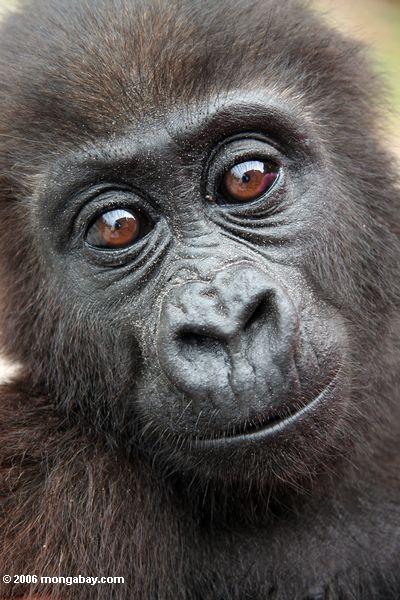
The largest of the great apes, an average male gorilla weighs around 193 kilos (425 pounds); females are about half the size. Males have powerful jaws, huge muscular arms with an impressive span of over 2 metres (7 feet) and are about 10 times stronger than a human. Gorillas live in family groups called troops that can range in size but usually consist of one adult male, several of his females and their offspring – and the bond in these families is very strong. A sexually mature male has silvery grey fur covering his back, hence the term ‘silverback’. It’s the silverback’s job to keep his troop safe, settle any group squabbles, and it is he alone that mates with the adult females in his family. But younger males may encroach on a silverback’s territory trying to mate with his females or trying to take over his family altogether. If it comes to blows these battles can be brutal but most males try things like posturing and displays of strength to intimidate each other in hopes of avoiding outright fighting.   


Yet for all their strength and the occasional territory battle, these beautiful animals are incredibly quiet and peaceful. It only takes one look into their eyes and a few moments of study to see how similar they are to us – and it’s incredible. Amazingly, although they are the largest of the apes, they have a vegetarian diet. They eat fruit, vegetables, bamboo, thistles and other plants; occasionally they may eat some insects but that’s not a staple in their diet. They move throughout the day, constantly grazing in order to fuel their large bodies.  


As with most animals, gorillas are divided into different sub-species. Western lowland, eastern lowland and mountain gorillas are likely the most familiar to you. Gorillas live in the rainforests of Central and West Africa, although the mountain gorilla lives in montane rainforests. Unfortunately, gorillas are  critically endangered and total numbers are estimated somewhere between 120,000 - 125,000; mountain gorilla numbers are very low with only about 786 individuals. Rampant deforestation, mining and illegal hunting for their meat and trophies is pushing these incredible animals to the brink of extinction. There are many great conservation organizations working hard to save them. One you may have heard of is the Dian Fossey Gorilla Fund International, http://gorillafund.org/. It was Dr. Fossey who made it her life’s work to study mountain gorillas starting in 1966, and it is because of her (and those who have continued her work) that we know much of what we do today about these incredible apes.    

Another great organization is The Mountain Gorilla Veterinary Project. They work tirelessly with the very small remaining mountain gorilla population helping to keep them safe and healthy. Check out their website at http://gorilladoctors.org/, it has great information and there’s even a blog you can follow.


Returning to Tarzan for a moment, I think the reason I love the story so much is because it teaches us about compassion for other beings; Kala, a female ape loses her own baby and is devastated so when she finds Tarzan she adopts him, raises and loves him the same way she would have the baby she lost. The story teaches us to celebrate our similarities and not to focus on the things that make us different. We all need a family, a safe place to live, food, and water – as Phil Collins sings on Disney’s Tarzan soundtrack ‘we’re not so different at all.’ This is not only true of gorillas, but of all other beings and if we started to think about things in this context I believe the planet would be in better shape, definitely a kinder place to live. A little something to contemplate as you put your children to sleep and dream about their futures.

Monday, November 21, 2011

The Spotted Wind

I’ve always been partial to cats. Growing up we had a family cat and as an adult I’ve had 3 feline friends to date. When it comes to their wild relatives I don’t have a favourite really – they are all amazing in their own way – but there’s no denying how absolutely fascinating I find the cheetah. During my visit to Tanzania in 2008, I was fortunate enough to see wild cheetahs; I saw them in both the Serengeti National Park and Ngorongoro Crater. And wow, are they ever beautiful!


Cheetah in Serengeti National Park ©Lenore N

Unlike lions or leopards that are built for strength, cheetahs are built for speed. They are the fastest land animal on the planet reaching speeds of about 110 kilometres per hour (70 MPH)! A few weeks ago I wrote an entry on animal adaptations. I talked about the difference between generalist species and specialist species. Cheetahs are most definitely specialists. But what is it that makes the cheetah so fast? It’s their amazing structural and physiological adaptations that allow this cat to move as fast as it does.

They have a flexible spine allowing all four paws to be off the ground at the same time, long legs to propel them forward, semi-retractable claws for gripping the ground as they run, a long tail that acts as a rudder for balance as they turn on a dime, a big chest cavity for their large lungs and heart to pump the amount of oxygen and blood needed to run at those speeds, small dentition (especially their canines) allowing for an enlarged nasal passage for taking in oxygen and small head and ears for aerodynamics.

This short video from BBC Nature Collections illustrates some of these adaptations:


Cheetahs are diurnal, meaning that they are most active during the day. Their spots provide excellent camouflage in the long African grasses as they wait for the perfect opportunity to ambush their favourite prey, Thompson’s gazelle. And because they hunt during the day, their black under-eye 'tear' markings help to reduce the glare of the sun. What, you didn’t think the NFL came up with that on their own did you?

Unfortunately, no matter how fast they are, they can’t outrun how quickly their numbers are dropping – the cheetah is endangered. At one time, these cats ranged throughout Africa and Asia. Now there are only an estimated 100 remaining in Iran and somewhere between 10,000 to 12,500 in sub-Saharan Africa; its last true stronghold is Namibia with about 3,000 individuals. Loss of habitat and conflict with livestock farmers who indiscriminately trap and kill them are severe threats to the cheetah. Add to that a decline in prey and competition with larger predators like lions and hyenas who may steal their kills and it equals big trouble for these incredible cats.  

One of the world’s leading cheetah conservation organizations is The Cheetah Conservation Fund, founded by Dr. Laurie Marker. They focus on conservation and management strategies outside of protected parks and reserves and their overall objective is to secure the survival of cheetahs in suitable African habitats. For more information on their work and for everything you could ever want to know about cheetahs, visit their website: http://www.cheetah.org/?nd=home.

It would be a tragedy to loose such an amazing and beautiful cat, one of nature's 'record breakers'. I hope to one day visit Namibia and maybe even spend some time volunteering for the Cheetah Conservation Fund. Until then, I have great memories of my time viewing wild cheetahs and I hold them close to my heart.

Tuesday, November 15, 2011

In The Shadow Of Giants

I fell in love with African wildlife as a kid and my dream was to one day visit the continent and see all its animals. When I got a little older and learned just how large and diverse a continent Africa actually is, I figured I’d start with the Serengeti and go from there!

In 2008, my dream finally became reality and I embarked on a 28-day trip to the land of sun. There are many, many stories to share about this trip and the three countries I visited – Tanzania, South Africa and Madagascar – but today, this story is about elephants.

Being the largest land animal on the planet, it’s hard to imagine anyone not being impressed by an elephant. An average male African elephant weighs around 6, 364 Kg (14,000 pounds) and stands about 4 M (over 13 feet) tall. Seeing one at a zoo is impressive, but seeing one in the wild is a whole different experience. I’m not sure I can accurately describe what that was like for me. Whenever I see an animal in its natural habitat, especially for the first time, I feel both excited and at peace...and I’m usually a little teary-eyed to boot. And when it’s a large animal like an elephant, the wow factor is big!

On my very first day of safari, I couldn’t wait to finally see the animals I had been waiting to observe in the wild my whole life. And I wasn’t picky; I didn’t have a check list, I wanted to see it all! I was travelling with a friend who felt the same way and we were SO excited to get going. We arrived at the first place on our tour in Tanzania, Tarangire National Park. Our guide went to check us in and I decided to use the bathroom before our drive. While in there, I heard zebras in the distance through the open window and at first it was so surreal it was like I was hearing a recording playing on a PA system rather than actual wild zebras in the park beyond the bathroom. Oh my god...I was in Africa!

The first animal we saw was a giraffe, but it was far below us in a valley and although we were ecstatic, our guide promised we would see animals much closer then that as we drove on. We then came upon an African fish eagle sitting in a large tree and again were thrilled because we weren’t sure how many birds of prey we’d end up seeing during our visit. It wasn’t too long after we’d said goodbye to the eagle that it happened – we saw our first elephant!

Bull elephant in Tarangire National Park © Lenore N

 It was a male and he was alone walking through the tall grasses. He saw our jeep stop and he watched us calmly as we scrambled for our cameras all the while whispering excitedly. He was magnificent and beautiful and yes, I got a little teary. For such a large creature, he was amazingly quiet. The thing I find challenging when seeing a wild animal is the desire to capture as many pictures as I can while balancing that with just sitting and observing. But since this was my first wild elephant encounter ever, the camera won out and I snapped picture after picture – gotta love digital! Fortunately, we had many opportunities as the trip went on to sit and observe these amazing giants.

Mom and baby in Serengeti National Park © Lenore N

Over our planet’s history, there have been 252 identified species of proboscidea (the taxonomy order to which elephants belong) which includes the prehistoric woolly mammoth. Today, there are only 2 species of elephants left, African and Asian. As I’m sure you’re well aware, those 2 remaining species have been driven to the brink of extinction for their ivory tusks. And although the trade is illegal, it continues to thrive. Add habitat destruction and human-elephant competition for space to the mix and these animals have got huge odds stacked against them. They are large, far roaming species that need lots of space to survive. The elephant population in Africa is not as low as that in Asia, where they only number somewhere between 25,000 to 35,000 wild individuals. There are about 600,000 African elephants across 37 countries – and this number is largely due to vast conservation efforts over the past 30 years. But while they may be stable in certain areas where protected, they are far from being safe with all the pressures on them. 

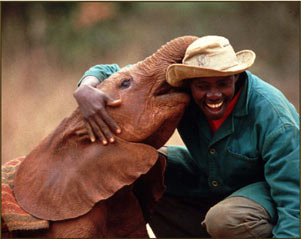
One organization doing amazing work is the David Sheldrick Wildlife Trust (http://www.sheldrickwildlifetrust.org/) in Kenya. They take in young orphaned elephants whose families have been killed by poachers or have ended up affected by some other human-elephant conflict that has left them alone. Regardless of the reason, these young elephants wouldn’t stand a chance without the help of the Trust. The individuals who work there are truly some of the most caring and compassionate people on the planet. They spend day and night with these orphans nursing them back to health with the goal of one day releasing them back in the wild. 60 Minutes and The Nature of Things have both run programs on this organization so if you think it sounds familiar, that could be why.  Please visit their website and learn more about their work. It’s very expensive to care for these animals and they have a great foster program you might be interested in. I fostered an elephant in the past and loved getting photos and updates; it was very rewarding to hear about her progress.

© David Sheldrick Wildlife Trust 

 Everyone has the power to help elephants whether by avoiding products made from ivory, donating to an organization working on elephant conservation and/or educating other people about the issues threatening these amazing animals.   

The experience of spending some time with wild elephants in Africa is one for which I am eternally grateful and one I will remember forever. 

Monday, November 7, 2011

Breaking The Ice

I thought I would share a story about bars and pickup lines because I think this one is very funny. You may be wondering, “What could this have to do with wildlife and conservation?” Read on and you’ll see the connection.
In May of 2007, I went to Halifax for a few days. The organization I was with at the time has an office there and I was promoting our new teacher resources by visiting a couple of schools and talking to elementary children about wildlife conservation.
This was my first visit to Halifax and I was really excited. First, because I LOVE to travel and second because two colleagues from Toronto had gone to work at our office in Halifax for a year and I was going to hang out and explore the city with them.
If you’ve ever been to Halifax, you’ve no doubt been to the Lower Deck. As I learned, it’s THE pub to visit and have a pint or two while listening to one of Nova Scotia’s many fantastic local bands. We had a great night with lots of laughs, but what made this night particularly memorable for me was an exchange that took place between me and some random guy. Apparently, there is a pickup line that goes like this:
Guy: Do you know how much a polar bear weighs?
Girl: No
Guy: Neither do I, but it’s enough to break the ice!  

Now if you’ve been following my blog entries, you’ll know that one of the species I’ve been lucky enough to work with is the polar bear. So in my mind - because I hadn’t yet heard this line - this guy had been chatting with one of my colleagues, found out what we do and decided to talk to me about polar bears. Poor guy! And keep in mind that the music is loud so we’re yelling over it. Here’s how the exchange went:

Guy: Can I ask you a question?
Me: Sure.
Guy: Do you know how much a polar bear weighs?
Me:  Yes, do you want that in pounds or kilos?

Pause...

Guy: (looking at me like I’m crazy) What?
Me: What?
Guy: Never mind.
Me:  (confused): Wait...what?
Guy: Nothing. (tries to walk away)
Me: (still confused): What just happened here? Did one of my colleagues tell you to ask me that question?
Guy: (still looking at me like I’m crazy) No. I don’t know what you’re talking about.
Me: Well then why would you ask me that question?
Guy: (slightly annoyed) Well why would you answer it like that?
Me: Because I work for a conservation organization and polar bears are one of the key animals I work on.
Guy: Oh, that’s weird.
Me: So, what response were you looking for?

So then the poor guy goes on to tell me about the pickup line, completely embarrassed by this time. Needless to say, he left abruptly after that while I was laughing – at the situation, not him...well ok, maybe a little at him for trying that line in the first place – and looking for my friends to tell them what had just happened. I mean, what are the chances of that?

And that is by far the BEST line I’ve had used on me! I often wonder if that guy ever got the nerve to use it again. Oh, and in case you were wondering, the weight of a polar bear depends on age, sex, the season and which subpopulation we're talking about (especially for those fasting during their time on land). There's a wide range, but on average an adult male bear weighs around 400 kilos or 880 pounds – some weigh more and some weigh less. Females usually weigh about half of what males weigh.

  
Polar bears have the amazing ability to displace
their weight evenly so they can walk across ice
that wouldn't even hold the weight of a human
© Lenore N